Figure A below is a MRI image of a sarcoma in Carl's neck as of Jan 5, 2011 with some added 'visual' information. In photo shop I added colors and labels, and drew a rough outline to help you orient the placement of the head, which hopefully helps you better understand the MRI.
 In Figure A, the vertebrae (neck bones) are in green. The vertebrae part on the left in green (front of the neck) rings the spinal column and connects to the green part on the right (in the back of the neck).
The photo below shows a neck vertebrae bone as it would look if your were looking from the top of the head. You can see how the bone has a ring. The ring circles the spine.
In Figure A, the vertebrae (neck bones) are in green. The vertebrae part on the left in green (front of the neck) rings the spinal column and connects to the green part on the right (in the back of the neck).
The photo below shows a neck vertebrae bone as it would look if your were looking from the top of the head. You can see how the bone has a ring. The ring circles the spine.
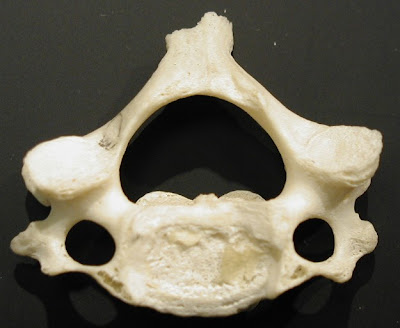
The next visual labels different parts of the vertebrae.
 In Figure A, the spinal column (in yellow) is protected by a fluid filled sack. Perhaps you can now see the bad news of Figure A.
The nasty sarcoma tumor (shown in red on Figure A) is impinging (almost touching) the spinal column. It is squishing the fluid filled spinal sack. Unfortunately, the sarcoma tumor has also eaten away and destroyed part of the bone in the back of the C2 vertebrae, and possibly others (C3?). Destroying parts of the bone of the vertebrae - Bad. Touching the spinal column (i.e. the spine) - Well, that would be way worse.
Below are images from a CT scan of Carl's head taken from the top of the head looking down. This CT scan is from January 5, 2011. CT scans show bone details clearly. You can see the vertebrae glowing in white. Instead of being shaped like the photo above, the white bone has been replaced on the right with ominous gray tumor material.
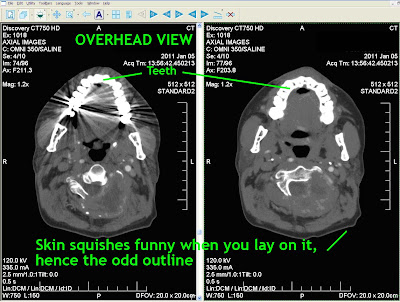
Below are three MRI images of the same cross section, again, from Jan 05, 2011. Above, CT scans, below MRI scans.


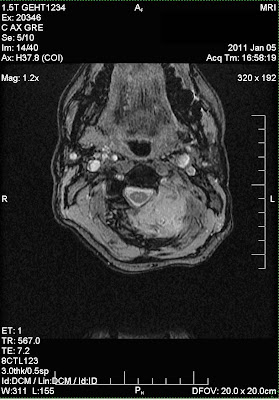
The three MRI images show different ways the MRI contrast can be adjusted to better see various types of tissues.
The final two images below are from a CT scan adjusted to show different structures. The views are a cross sections of Carl's neck from the back (image on the left), and a side view of the neck (on the right).
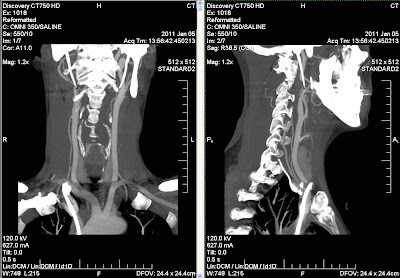 These images document why the sarcoma tumor in the neck had to be surgically removed. Carl had surgery to remove the tumor on January 24, 2011.
Click on any images to see it larger (and less blurry.)
When it comes to cancer care in 2011, in the United States, here in Wisconsin, the engineer and photographer in me is grateful and proud of the available digital diagnostic technology. The technology is improving exponentially.
Like the expansion of the Internet and the digital camera, diagnostic imaging is improving cancer detection, monitoring, and care. I don't like the fact that Carl has cancer, but if you have to get cancer, (and you can't delay getting cancer into the future), now is the time to get it over any other period in time, any other millennium, century or year. The 'technology', drugs, and care is improving. Teams of engineers, scientists, technicians and doctors have created the technology I am going attempt to show you below.
Don't let the fact that this technology is cool make you think I am in any way happy that my husband has cancer. The pep talk above does not make it any easier for me to use photo shop to try to document this tumor. I am doing this (originally) for my children; also my spouse, our relatives and friends; and others who may stumble across this post trying to understand cancer. I do not like spending time trying to make the images understandable. But I think I can use my time to help some people understand more about cancer, or Carl's cancer, where ever their interest might lie.
Below are some MRI images that show the tumor in Carl's neck as of Jan 5, 2011. MRI stands for Magnetic Resonance Imaging. See Wikipedia for technological information on MRI's. Basically, MRI's use a large machine, a lot of physics and a lot of engineering to take multiple cross section photos of a part of the body, in this case Carl's neck.
If you can't see how Figure 1 or Figure 2 are images of a view of a neck, see Figure 3 and 4 below for some added 'visual' information which may help you to be able to better understand the MRI's.
Figure 1 is a MRI of a sarcoma in Carl's neck as of Jan 5, 2011. This is a view as the doctor or technician can see it on their computer screen. On the computer, the doctor can manipulate settings like contrast.
 Figure 2 is a MRI of a sarcoma in Carl's neck as of Jan 5, 2011 with different settings, as the doctor or technician can see it on their computer screen. Notice how the neck vertebrae (the bones) stand out differently then in Figure 1 above. In Figure 1 the vertebrae (bones) are gray, in Figure 2 the bones are dark and stand out more. The tumor is more visible in Figure 2 when the bones are dark.
 Figure 3 is Figure 2 with some added 'visual' information. I took the Figure 2 above and in photoshop I added colors and labels, and drew a childish outline to help you orient the placement of the head, which hopefully helps you better understand the MRI. Figure 3 is NOT what the doctors see on their computer screens.
 Figure 4 is Figure 2 with some added 'visual' information. It is my first attempt at showing what parts are what. I took the Figure 2 above and in photo shop I added labels, and drew a childish outline to help you orient the placement of the head. Figure 4 is NOT what the doctors see on their computer screens.
 MRI's are good for showing tissues, and differences in tissues. Carl also gets CAT scans. CAT scans are good at showing bone and structures like veins. I hope to show you CAT scans on a different future post. Carl also gets some X-Rays, which are good for showing bones, although differently then in a CAT scan. The combination of MRI's and CAT scans give doctors knowledge (and a visual picture) of things inside the body that used to be able to only be seen once a surgeon cut the body open. Now, the doctors and surgeons learn much before any cuts are made.
My children find these photos interesting for several seconds, and then at some point the information creeps them out and they need to walk away. It is not just a screen shot, it is a tumor that once was in their dad. (Surgery removed almost all of the tumor in Carl's neck on Monday Jan 24, 2011.) I am telling you about my 11-16 year old children's responses so that you may be aware of and accept your own feelings. I find it easiest to view these images when I detach them from being my husband's neck images. (It is easier to view them 'clinically'.)
I waited months to post these images. Maybe you will understand why. Whatever.
The next blog post will talk about Carl's MRI more specifically.
MRI's are good for showing tissues, and differences in tissues. Carl also gets CAT scans. CAT scans are good at showing bone and structures like veins. I hope to show you CAT scans on a different future post. Carl also gets some X-Rays, which are good for showing bones, although differently then in a CAT scan. The combination of MRI's and CAT scans give doctors knowledge (and a visual picture) of things inside the body that used to be able to only be seen once a surgeon cut the body open. Now, the doctors and surgeons learn much before any cuts are made.
My children find these photos interesting for several seconds, and then at some point the information creeps them out and they need to walk away. It is not just a screen shot, it is a tumor that once was in their dad. (Surgery removed almost all of the tumor in Carl's neck on Monday Jan 24, 2011.) I am telling you about my 11-16 year old children's responses so that you may be aware of and accept your own feelings. I find it easiest to view these images when I detach them from being my husband's neck images. (It is easier to view them 'clinically'.)
I waited months to post these images. Maybe you will understand why. Whatever.
The next blog post will talk about Carl's MRI more specifically.
Click on any images to see it larger (and less blurry.)
Wow, it has been a while since I have done an update. Perhaps no news is good news? It's been so long I'll do a brief summary of 2011 with regards to Carl's medical journey. I'll start with December, just 'cause.
Dec 27-Dec 30, 2011 Carl had inpatient Chemotherapy at Froedtert. They let him out one day early so that he could enjoy New Years Eve and Day with his family.
Carl had the hardest time recovering from this particular chemotherapy, and pain increased in his neck. The Doctors decided to operate on his neck to stabilize his neck and debulk the tumor, and the neck surgery was done on Jan 24, 2011. Carl was sent home from the hospital wearing a neck brace, which he wore for 23 plus hours a day, except in the shower, for weeks, and instructions not to drive.
After the surgery Carl was recovering (sort-of) but then the pain in his neck was getting worse. The surgeon saw Carl, took an X-ray, and determined that Carl's spinal fusion had failed, and included a screw pulling out. Carl had an emergency surgery on Feb 14, 2011 to repair the failed hardware. On this surgery they pulled out the screws and put in larger screws, used acrylic glue and more hardware, and fused Carl's neck from the base of his skull to C7.
Carl was released from the hospital on Wednesday, February 16, 2011. After a week or so, Carl felt good enough to start working again, although with reduced hours. Again, Carl was sent home from the hospital wearing a neck brace, which he wore for 23 plus hours a day, except in the shower, for weeks. He won't be able to drive a car for at least six weeks.
Life with the children, of course, continued, and the weekend of Feb 25-27, 2011 was particularily busy. Anthony (a freshman) was in a great musical for 4 days, Miranda (6th grade) was in forensics, and the three younger children had a piano recital, and poor weather made some things more difficult. We survived the activity, but Carl overdid it that weekend. The funny thing about overdoing things is that "hindsight is 20-20". After you overdo something, you know that hey - you overdid it, you shouldn't do that. But by then it is too late. Fortunately, Carl survived, with no ill effects.
The 2nd surgery's spinal fusion has lasted longer and worked better then the first surgery, so far. On Thursday, March 10, 2011 I took Carl to see the surgeon for a post-op appointment. Carl had an X-ray and the surgeon said things look great. He even said Carl could start wearing the neck brace less (an hour or two each day), and that Carl should start PT (Physical Therapy) next week.
This week, later today, in fact, Carl will meet with the radiation Doctor, and 'the doctors' will start planning the next link in the chain of treatment.
On Monday, Jan 24, 2010 Carl had a surgery at Froedtert Hospital to de-bulk the tumor in his neck. The surgery goals were to remove as much of the tumor as is safely possible, stabilize the neck, and relieve the pain that Carl has been experiencing recently. The surgery and procedures went well, started about 7:30 AM, and ended about 3:30 PM. Carl went to the recovery room, and at about 6:00 PM he was wheeled into his hospital room on the 5th floor of Froedtert, where I first got to see him since 7:20 AM in the morning. He was groggy, in pain, and very still, but otherwise doing well. By 8:30 PM he had walked half the length of a hall, taken some steps and was back resting in his bed for the night.
 |
| Carl recovering |
Below are the bloody details only for people interested. Don't read below if you are the sqeamish type, the summary above should tell you enough.
Carl was scheduled to show up at 5:30AM for a 7:15AM surgery. Carl was in the hospital already, recovering inpatient from Friday's angiogram with embolization procedure, so 'early arrival' was somewhat easy (for Carl). The surgery was scheduled to start at about 7:15AM, I left him at about 7:20 AM as they wheeled him in to surgery. Carl was out under general anesthetic at about 7:30AM.
First the surgery team "installed" multiple IV's (including one called an arterial line), a breathing tube and a foley catheter. At some point after the IV's and breathing tube and catheter were in, Carl had to be carefully lifted off the portable hospital bed (where he was laying on his back) and turned over and placed lying on his stomach on the surgery table, with his neck position immobilized the entire time. This procedure alone takes a fair amount of time (and coordinated teamwork between many people), because head can't be rotated independently from the body. (The operating team does this type of positioning roll with people with broken necks from accidents, so they are used to the procedure, but that doesn't mean it is easy.) The length and positioning of IV lines are carefully thought out in advance so that lines don't get crossed, pinched, or end up getting in the way of the surgery personnel or equipment. Carl hasn't been able to lay on his stomach for about a year because of his port, which sticks out from his chest. Padding and positioning of sponge like O-rings takes care of this, but again, it all has to be thought out in advance.
It is my understanding that the skull was locked into place with screws through Carl's skin into the bone of the skull, and X-ray imaging photos (and MRI?) were made so the surgeon could "see" precisely where the tumor lay before the first cut. I am guessing that these steps were done after Carl was rolled onto his stomach. Throughout the operation neurological functions where checked with monitoring impulse signals being sent and received from the head to the limbs, this functioning being entirely monitored by a neurological Doctor and his team. At points throughout the operation progress was checked with more X-rays.
This preparation, monitoring, imaging and other setup steps took until about 9:53 PM, when the first cut was made and the "surgery" officially began. The surgeon made an incision into the back of Carl's neck, 4 to 6 inches long, (I haven't seen it yet) and started the process of carefully removing the tumor through the back of Carl's neck. The surgeon did not try to remove all of the tumor, particularly the tumor that lay along Carl's main vertebral artery. Accidentally harming this artery could be fatal. The tumor that lay next to the spine seemed to neatly "peel away from the dura", which was a nice turn of events. It is my understanding that the surgeon cauterized the edges of the blood vessels that fed the tumor, hoping to prevent them from regrowing and resupplying tumor growth.
The tumor in Carl's neck had invaded and eaten away some bone in Carl's neck. There are 7 neck bones, called vertebrae, labeled C1 to C7 from top to bottom. The neck vertebrae C2 and C3 had lost bone material to the tumor, mostly the spiny pointed part on the the back of the neck bone. (The 'ring' portion of the vertebrae was still intact, but weakened). The tumor was removed here, along with some bone, and the neck was then fused with titanium metal hardware from the skull, through C1 to the intact C4 vertebrae. The fusing will stabilize the spine, but will result in some loss of movement in the neck. However, in the proceeding weeks, Carl has been in so much pain that he already stopped turning his head much. It is possible that he will have more movement (in several days) then he did immediately proceeding the surgery.
Carl received two units of blood, about 1000 ml, as blood transfusions throughout the surgery. (Thank you to all who have ever donated blood. Its not fun, but it is important.) The surgeon indicated that five years ago he would have expected Carl to lose about 5000 ml of blood in a surgery of this type, and he was surprised at how little blood was used. This was the reason that they did the angiogram with embolization procedure on Friday, and it was very successful in minimizing the blood loss. I expect it helps lower the surgeon's stress level as well - I looked at my pyrex measuring cup and thought of 500 ml of blood spilling all over my floor. Then I thought of 5000ml (more then a gallon of blood) spilling out of someone's neck as you are trying to do a careful job of identifying healthy cells from tumor cells, removing the tumor cells, and then building a superstructure of titanium in a living person's neck, and I was grateful for Friday's procedure.
They were closing Carl's surgery from about 2:00PM on until the surgery ended about 3:20PM. Carl was then taken to the recovery room. I met with two anesthesiologists at around 3:40PM, after they had stopped the anesthetic and removed the breathing tube and left Carl in the recovery room, (where visitors are not allowed). At about 3:45 PM I talked to the neck surgeon on the phone briefly before he went in to his next surgery. The neck surgeon indicated the surgery went well and he was pleased with the results.
Carl was in the recovery room until about 5:45 PM, and before 6:00 PM he was wheeled into his hospital room on the 5th floor of Froedtert, 5 South East room 25, where I first got to see him since 7:20 AM in the morning. It felt great to see Carl after all that time. My brother Tom stopped by within 10 minutes of Carl arriving at 5 SE room 25, which is in the 'Spinal Injury' Center.
Carl was groggy, thirsty and in pain, able to talk but only in a pained whisper, and was occasionally quietly agitated and anxious. His eyelids were very puffy (from having been laying on his face for hours), and he used his fingers to open his eyelids now and then, but mostly kept his eyes closed. He was very thirsty. As soon as the nurse 'read his orders' (instructions from the doctors), I was allowed to feed him ice chips. Carl was mumbling about water rights, and how people should not steal water. (This may be funny in the future, but at the time it just told me he was still pretty out of it.) My brother Tom kept saying "what?" every time Carl made some remark, and I kept making weird eyes at Tom effectively saying "I have no idea". It was nice to have Tom there at that time. Tom recently helped my brother Paul after a spine surgery, and he saw some of the similarities of the situations.
The neck surgeon stopped in to 5 SE room 25, and answered a few questions before leaving to arrange for more pain medication for Carl. Eventually pain medications were given and Carl settled down into a barely alert dozing state, waking to try to turn and find a more comfortable position. Tom left around 8:00. Carl had a neck draining blood from his neck (ok, yuck...) and woke up at around 8:30 PM when they emptied it. He wanted tubes out. The catheter could come out after he walked, and this motivated Carl. At around 8:40 PM he had walked half the length of a hall flanked by 2 nurses, with me pushing his IV 'tree' behind him. The nurses had to keep telling Carl to open his eyes. As soon as he was back in bed, he was asking them to take out things. The catheter came out, and arterial IV was removed, and the pain medicines were kicking in, and Carl fell asleep by about 9:15 PM, (after numerous times of shifting around his position, and Carl having me and the nurse change the incline of the bed, and location of pillows, etc.) He fell asleep, and his pulse below 60, which tells me that he wasn't in pain. (Of course, I had to first go and checked with the nurse to make sure the pulse rate that low was OK.) Carl didn't stir at all after about 9:20, and I left a little after 10:00 PM to drive home to my sleeping children, who had been fed and cared for by a team of friends that day on Monday alone. Thank you all.
Please pray that Carl recovers quickly and well, and that the tumor is mortally damaged and unable to grow back.
Happy New Year, 2011!
 Carl and I and the children ended 2010 as we have been ending the Year for over a decade now - welcoming in the new year with some college friends and our eight assorted children, all born within 5 years of each other. (I think Carl and I visited each child in the hospital when they were born.)
 It was a good way to close out the decade - We have been getting together for New Years Eve with these friends every year since before the turn of the millenium. (Photo above from Dec 31, 2000.)
January ushered in cold weather and more pain in Carl's neck. Multiple Doctors reviewed Carl's case, and are now recommending that Carl has a surgery to de-bulk the tumor in his neck. They considered this surgery before (in April 2010), and decided not to operate, (and at the time we were glad!). Now that the neck is giving him more trouble, the plan is that Carl will have surgery on his neck near the end of January 2011. [Update: The Surgery was on January 24, 2011] (Keep Carl in your prayers, PLEASE!)
It was a good way to close out the decade - We have been getting together for New Years Eve with these friends every year since before the turn of the millenium. (Photo above from Dec 31, 2000.)
January ushered in cold weather and more pain in Carl's neck. Multiple Doctors reviewed Carl's case, and are now recommending that Carl has a surgery to de-bulk the tumor in his neck. They considered this surgery before (in April 2010), and decided not to operate, (and at the time we were glad!). Now that the neck is giving him more trouble, the plan is that Carl will have surgery on his neck near the end of January 2011. [Update: The Surgery was on January 24, 2011] (Keep Carl in your prayers, PLEASE!)
First a special Doctor will do a procedure called an angiogram a day or two before the surgery. They will do an angiogram with embolization. Embolization is kind of the opposite of an angioplasty - the Doctors will attempt to kill and destroy the blood vessels that are supplying the tumor. [Update: The angiogram with embolization was on January 21, 2011]
On surgery day a neck surgeon will carefully remove as much of the tumor in Carl's neck as he safely can, approximately 90-95%. The surgeon will not try to remove it all, there are important nerves, blood vessels and spine stuff he doesn't want to get too close to. (The neck is a pretty important part of the body.) The surgeon will also try to cauterize (kind of burn to a crisp?) the blood vessels that are looking like they might want to supply the tumor area. A downside of removing the tumor is that the surgeon will then have to fuse several of Carl's neck vertebrae (C1 to C4, for those curious). An upside of this fusing procedure is that Carl may (with luck) actually have more neck mobility then he currently has now. Carl is in enough pain that he really turns his head very little at the moment. Carl will hopefully stay in the hospital for only a couple of days, stabilize, and then go home to recover. He will not be able to drive for 6 weeks.
I was glad the doctors didn't recommend this procedure in April of 2010, but now I really want the days to pass quickly until the surgery is over and done with. Carl has not bounced back from the last chemotherapy (which ended Dec 30, 2010) like he has from previous chemotherapies. Carl's pain is barely controlled by the medication he is taking - daily Oxicodone, with Oxicontin and Tylenol for 'break through' pain, of which there is a lot. The pain drains him of a lot of energy. It's hard to watch someone in pain and be unable to help in any meaningful way. Carl has lost weight for the first time in a year. Through this month he has been dragging himself to and from work as well, and I don't know whether to encourage or discourage this. (He probably wouldn't take my suggestions, anyway.) He basically comes home and collapses, sleeping an incredible amount, leaving me to wonder if I should wake him up to encourage him to eat, or let him sleep. I don't know the answer. When you get married they don't give you a book that tells you what do do in situations like this. I actually pray that I am not messing it up too badly.
I'm glad we made it to this weekend, (Jan 15 and 16), where Carl can rest, eat, and rest more. Next week the children have off Monday and Friday, and the two in high school have "exam week", and then we will tackle the medical procedures. Hopefully all will go well.
May your 2011 be healthy.
We last left off December 22, 2009, the happy day where Carl got his port placed. Many of these fun new terms (ex. port) will be defined in later posts.
- 2009 Dec 23, Wednesday:
- We woke up calm and relaxed, a plan (and port) in place. We got the children off to school.
- Carl was showered and dressed, ready to go to work for a nearly full day.
- We get a phone call. Would we like to meet with the Radiologist? (by the way, TODAY?)
- 11:00 AM Meeting with the radiologist.
- The thing in your neck concerns us... (what thing?) Remember the PET scan on December 18? The first Scan including the head? Guess what...
- 1:00 PM Hi tech custom device to immobilize Carl's head and neck for radiation created (for photo see What Radiation looks like.)
- CT simulation of radiation to neck area done.
- I left Carl at Froedtert to collect the children from the last day of school for the year 2009.
- 4:00 PM Carl got Radiation #1 (of 10) and was driven home by friend. (see What Radiation looks like)
- The treat in treatments are starting, before Christmas even.
- 4:50 PM I got a call from an anguished Anthony. He was hurt at wrestling practice.
- 5:15 PM Carl home from Radiation #1.
- 5:40-7:45 PM Mom and Anthony at the urgent care facility, X-ray shows a totally broken collar bone with the two pieces of bone not even close to touching.
- 8:30 PM Pain medication prescription filled for Anthony and Carl.
- Lots of Christmas snow coming down.
- Children at home with Carl put up the Christmas ornaments on tree (front side only).
- 2009 Dec 24, Thursday:
- The children slept in at home - no school.
- 8:00 AM Carl got Radiation #2 (of 10) at Froedtert Hospital in Milwaukee, Wisconsin.
- Carl got a neck brace. (You have to be kidding, right?) After Carl indicated he was unlikely to wear the neck brace the nurse told him that one of his vertebrae had some bone that was partially missing... You don't want to be paralyzed, do you? (answer, nope, and Carl doesn't want a sarcoma either.)
- New song invented. "It's beginning to look a lot like cancer, Every-where they look..." [Sing to the familiar Christmas tune.]
- We went home and collected the children. They enjoyed the non-stop screen time while we were gone very much.
- Christmas Eve Party with family on my side of the family. Carl moved his head carefully and didn't wear the neck brace. He figured he would risk paralysis for one more day.

- I went home and Carl and I went to bed. Carl slept with the neck brace on. I sighed, then got up and wrapped the presents I had and put them under the tree.
- 2009 Dec 25, Friday:
- Santa left precisely 5 wrapped presents under our glowing (1200 lights!) tree. This does not compare favorably to the bounty from previous years. The children did NOT let us sleep in, and one present WAS open before all the family was assembled.
- The children still had a good Christmas anyway (It's not like we don't have any toys, after all), and a Shopping Spree Day for Saturday was discussed.
- Christmas Party with family on Carl's side of the family. Carl wore the neck brace. "Let the Freak show begin" Carl said as he walked in with his neck brace and cane. OK, this is not a great thing for Carl to say, and I probably should leave it out, but it's what he said, it's what he felt, and it's what I report here. Carl thinks he will blend more once his hair falls out.
- 2009 Dec 26, Saturday:
- Shopping Spree day with family and Uncle Paul. We got the children pretty much whatever they wanted [but alas, no XBOX 360, Anthony's dearest wish. Had the progress reports of multiple children shown more (some?) progress...]
- Lots of snow falling fast does not dissuade shoppers.
- Parking was atrocious at the stores and malls. Even handicapped parking was very full (Carl got a temporary disabled parking sticker with the cane). Carl thinks they must be giving temporary disabled parking stickers out to anyone who asks. (OK, lots of the humor going around is kind of dark at the moment...)
- 2009 Dec 27, Sunday:
- 11:00 AM Church service. (Carl, with neck brace and cane attracted some welcome attention - I love my church family! Thank you all!)
- 2009 Monday Dec 28, to Thursday Dec 31... :
- 7:30 Carl got Radiation
- 8:00 Carl got Chemotherapy
- Carl did other tests, labs, appointments...
Christmas and December 2009 will be remembered like no other... Each day of Dec 28, Dec 29, Dec 30, and Dec 31 were their own mini adventures... But I am now tired and will post this post, and I will have covered 2009. Sort of.
Happy New Year to all. (This I mean sincerely).
This is the first year in more then 15 years that I have not had my Christmas cards made and sent out before the New Year started. Something else to do in January 2010. I must make the cards, and I must get the photo, before Carl's hair falls out. After all, I scrapbook my Christmas cards into my Christmas Album. For that reason alone, if none other, I intend to create the Christmas cards, and send them out! [Note from May, 2010: I never sent out Christmas cards for 2009]